Tuesday, December 21, 2010

Cairo, Take One


What you might find wandering the streets of Cairo (those are cut up plastic bags on that line).

Once we returned to Dahab, we found out that our hostel guy, Jimmy, was blowing smoke up our butts. Pessimistically, I had thought this all along based on experience and because our own research found nothing. However, Betty was leading the charge on this and I was happy to try and be optimistic. We ended up in a cab to Cairo. It was not much more than the bus and it was a lot faster so I didn't complain. We went through that great valley north of Dabah for a 4th time and right past Mount Sinai again. When we got to the west coast of the Sinai peninsula we saw a very different Sinai. You could see oil rigs in the Gulf of Suez arm of the Red Sea and the coast was lined with oil refineries. This was not the tourist side of Egypt. The final step to leaving the Sinai Peninsula was to go under the Gulf of Suez via Ahmed Hamdi Tunnel (or whatever the name of the tunnel is inside that tunnel because the first tunnel was leaking). The access points to this tunnel were the most heavily guarded part of Egypt that we saw.


Crossing the Sinai desert one last time.


An oasis in the Sinai desert.

Even though we had finally got off the peninsula, the problem was that we had no connection in Cairo to get to Luxor. Jimmy had said he was checking on the trains, but never called us back. We had to call him. He had nothing for us. The final hitch in our plan was that our driver, after flashing everyone with his high beams for two hours from the tunnel to Cairo, let us off about 3km from the train station. He fed us a line that he wasn't allowed to go all the way into the city. 3km is not far when you have a bike and you know where you are going. We had bikes. We had no idea where we were going. It was dark. We didn't speak the language. The traffic was worse that Istanbul.


This Cairo crosswalk sign shows just one small example of the crazy traffic.

As I lead the indirect charge to the train station, Betty told me that I almost got hit a few times. I didn't notice. I was just trying to focus on the road ahead. We asked for directions multiple times and got sent in every which way. When we finally found the train station, we found out there were no trains for that night. The holiday feast of Eid was still going on. We went to the bus station and got the same story. Trying to find the bus station was great because it has an Egyptian name, but our guide book and the tourist signs in Cairo call it the Cairo Gateway instead.
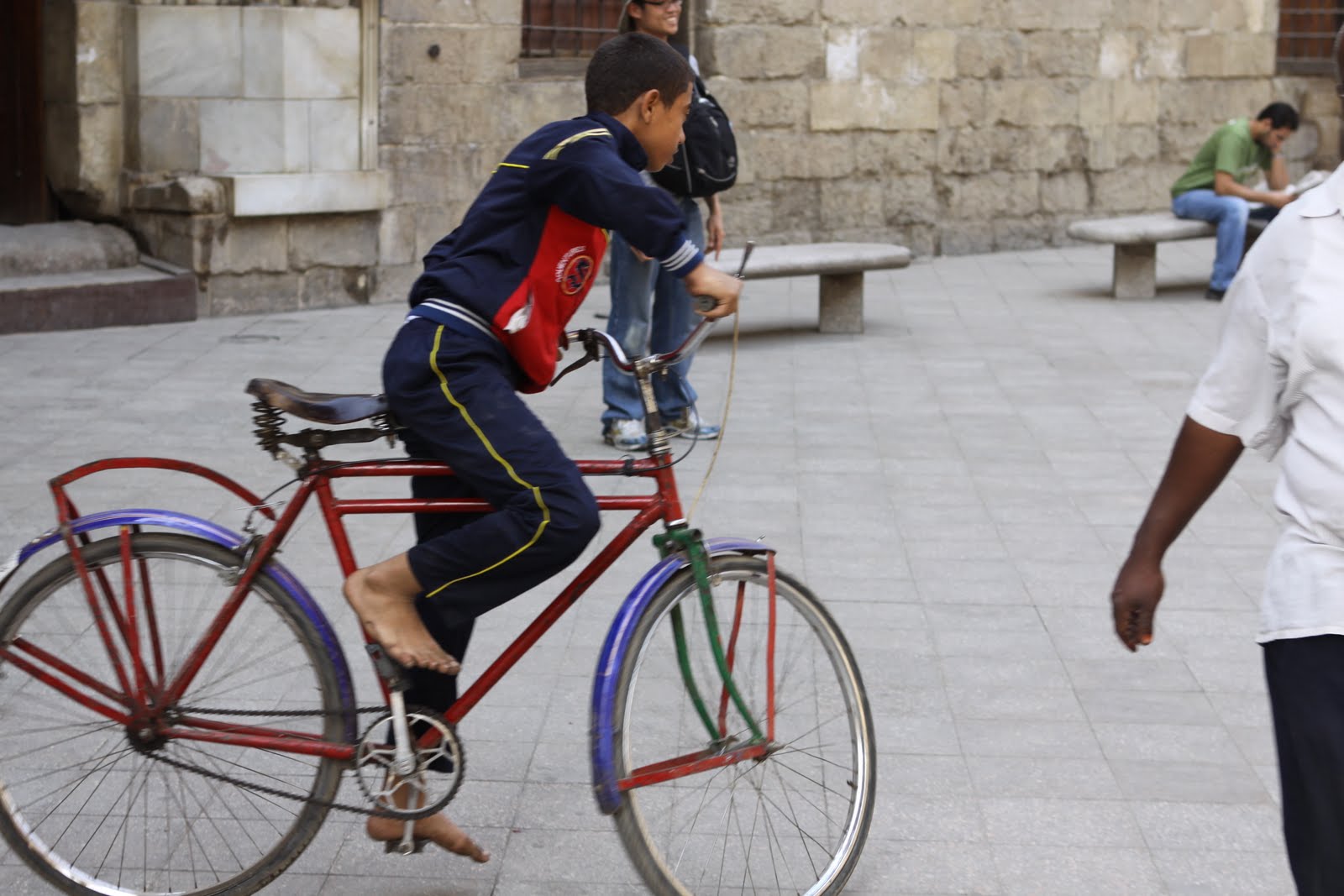

Egyptian bicycles all have the double horizontal crossbar.

Outside of almost being run over, the most interesting site that night was watching a horse act up on the road about a block from the bus station. It had a cart. It backed up and spilled the cart. Then, it started to pull forward into traffic. It was weird to see livestock in such a larger city, but it was only the very start of what we were about to see. I'm not sure if it is always this way or if there was only so much livestock in the city for the holiday feast of Eid al-Adha. Greater Eid requires each family kill an animal to eat and share, usually a ram.


Of course, there is a herd of sheep in a major city.

So, despite our best efforts to get out of Cairo, we were going to be spending the night and an entire day there. We would catch an overnight bus to Luxor the next night. Everyone I talked to, that knows me well, said I would hate Cairo. I decided to trust them and not plan to spend much time there so it was a little bit frustrating to be spending an extra day there. However, we made the most of it.


This typical scene makes me question my stereotype that the Middle East has water shortage.

First up, we signed up for some local food. We went to a random restaurant near our hostel. They were billed as a vegetarian restaurant. It was late and they had run out of a lot of their food, so they only had two vegetarian entrees left. Betty ordered one. I ordered an appetizer. When the food came out, Betty received the entree she did not order. She said she ordered the other one. Our waiter said that was impossible because there was only one available. This is the same waiter who gave us two options over an hour earlier. Did I mention the service was incredibly slow? The quality service followed us back to our hostel where we had been told we would have 24 Internet access. When I woke up at 4am, I wanted to kill some time until Betty woke up. The Internet was not working. In fact, the computer was not working. I touched it and felt an electrical current going through me. I don't think that problem happened overnight. So many of the businessman seem incredibly hospitable. They will say anything they think you want to hear. I used to think it was a language barrier, but more and more I think it is a choice because there are very few repercussions from tourists who are always on the move to the next stop and don't want to waste time arguing.


Slaughtering sheep on the street.


Weighing the sheep.


I have never seen these fat-tailed sheep before.

The next day, we continued to try and make the most of it. We headed over to the Islamic Quarter. I wanted Betty to experience the bazaar and a couple mosques. She had not been in any yet and it is definitely part of the Middle Eastern experience. On the way over, we got to see what I can only guess is an impromptu slaughter house on the street because of the number of animals needed for Eid.
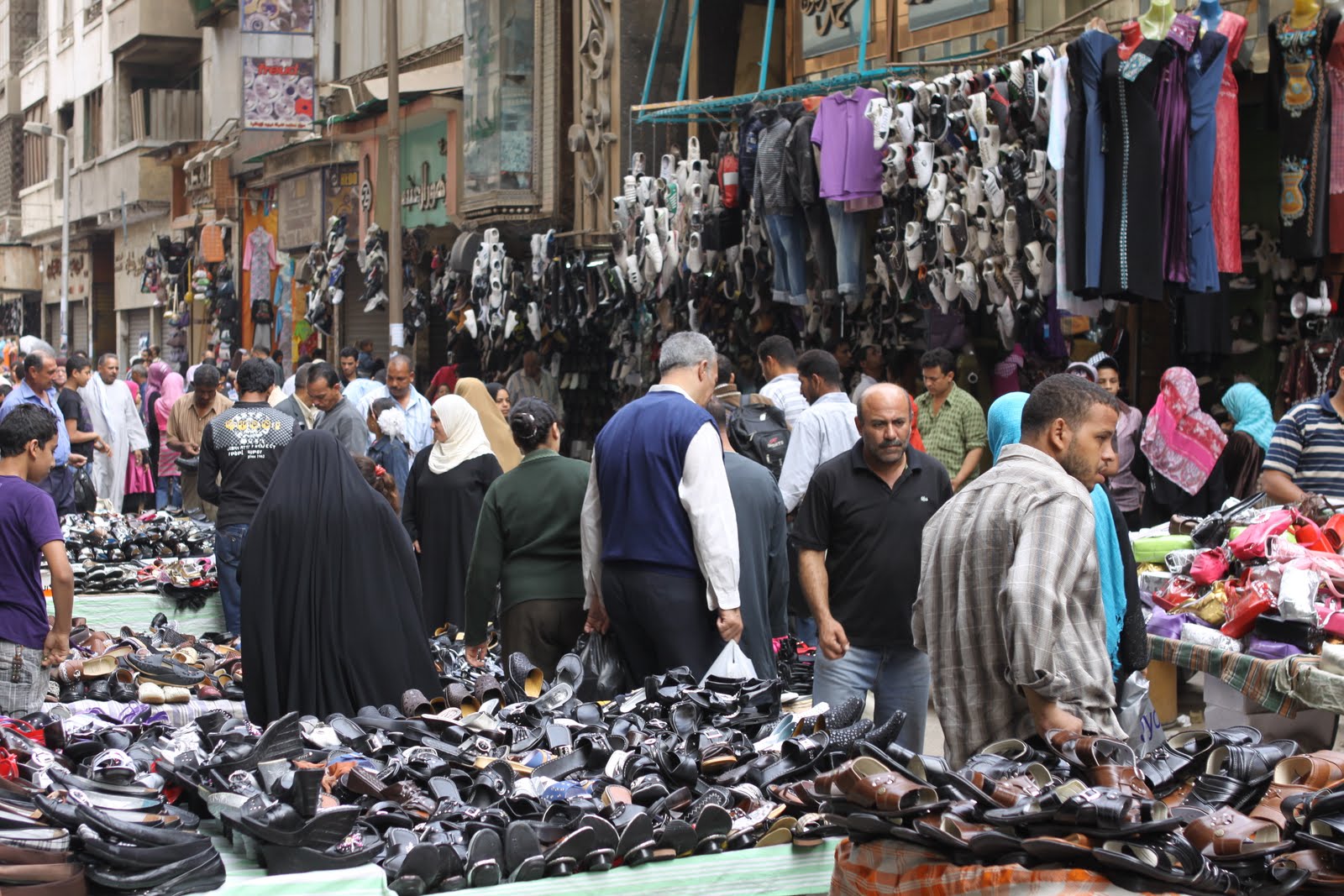

This might be the shoe quarter of Cairo.


Pick a bike, any bike.


Fireworks area of the locals market.

After that, we headed for Khan al-Khalili, the grand bazaar. I think this bazaar is mainly for tourists so it was lucky that on the way over, we ran into a few other bazaars that, I believe, were directed towards locals. They had everyday supplies instead of souvenirs. They didn't hassle us as much either. It was unbelievably crowded, even on a week day.


A Khan al-Khalili shop owner trying to make a sale.


A random street in Khan al-Khalili.


A bakery in Khan al-Khalili.

After wandering around a bit, we did find Khan al-Khalili. It was early enough that we were able to look around without getting harassed too much either. That was nice. After exploring and getting lost, we stopped for some chai at a 200 year old traditional coffeehouse. I'm not sure what that really means, but it there were people smoking sheesha, as always.


Shoe shiner trying to make a sale in the Khan al-Khalili


Fishawa coffee shop in Khan al-Khalili.

From the coffee shop, we wandered back into the Khan al-Khalili and through the Islamic Quarter to find the garlic and onion market. I wanted to see it because I couldn't conceive of an entire market dedicated to them. While we weren't finding it, we stopped in the most amazing mosque I have seen yet, the Al Hakim mosque. It was so beautiful and serene.


Al Hakim Mosque courtyard.


Al Hakim Mosque columns.

Islamic Cairo was my favorite part of the city. It was a little bit quieter because some of the streets were too narrow for honking cars to drive on. Of course, that just meant all the people were pushed together tighter instead. I'm not sure why the area is called Islamic Cairo. All of Cairo is Islamic. It might have to do with the high concentration of mosques in the area. I remember six, but I think one guide book said there are ten. In the City of 1,000 Minarets, I'm not sure if this is actually a lot of mosques for a small area. There is a lot and these are some of the grandest. One of them, Al-Azhar, claims to be the oldest university in the world, built in 970AD. Western definitions of university, not surprisingly, rule out Al-Azhar. The University of Nalanda in India is older, but was destroyed and rebuilt. There is also a university in Fez, Morroco that makes a claim back to 659 AD. Who knows. They are all old.


Bab El-Futuh (Gate of Conquest), a northern gate of the Old City, now the northern boundary of the Islamic Quarter.


Al Aqmar mosque


Islamic Quarter street.

When we finally left the Islamic Quarter, we headed for the Museum of Egyptian Antiquities. I am not normally a museum guy, but this one did the trick. They had a ton of stuff from old temples and looted tombs. It was great to see so much old stuff preserved. However, Betty also pointed out how poorly it was protected. A lot of the stuff was out where anyone could touch it. Other stuff was just in a glass box. Maybe since it has lasted 4,000 years, they aren't worried about it suddenly falling apart. One of the most curious exhibits was a small section with curvy statues that had a more sexual presence. Most Pharaoh statues aren't as close to regular human form.


The Egyptian Museum of Antiquities (photo by Sailing Tours, because you are not allowed to take pictures in the museum and I actually obeyed.)

When we left the museum, we went looking for a koshary restaurant. Apparently, koshary restaurants only serve koshary and it is supposed to be a great vegetarian dish. On our way to find it, we asked directions. A guy insisted on walking with us a bit, which is always a bad sign. It usually means he is about to try to sell us something. He showed us his cab and told us that if we need a ride, we should come see him. I thought we were in the clear, but then he followed us a little farther. On the way to the koshary, he showed us where his shop was. Betty poked into another store and I was left alone with the guy. I wanted to wait on the street for her, but he forcibly pulled me into his shop by surprise. My anger rose. As soon as we were through the door though he let go, which was a good thing because I was just about to respond physically to get him to let go. That isn't my normal response, but the Middle East has been wearing my patience down and him grabbing me like that had put me over the edge. Somehow, I thanked him for guiding us part of the way to the koshary and left. He started whining, but I didn't hear him. I needed to leave.


Koshary.

We finally got to the koshary. Koshary is a great way to fill your belly. It won't be your best meal. It won't be your most nutritious meal, but it will be fast and it will be filling. At the restaurant, the only thing they make is koshary so you just tell them a size and they fill you up. They fill you up with short spaghetti looking noodles, brown rice, macaroni, fried onions, lentils, and chickpeas. You can top if with vinegar or a spicy tomato sauce. This became our go to meal for a couple days when we were looking for something quick.


Burqa mannequins with what might be every variation of the burqa.


Angry mannequins (photo by B. Cremmins).

After dinner, we wandered back to pick up our bikes out of storage at the hostel. We biked up our street which was a major shopping area with some crazy store displays for the last time. Then, it was back into the thick of traffic for our crazed ride back to the bus station. It was a lot easier this time at dusk and having been there once, but it was still pretty crazy. When we got there, our bus driver said nothing to us, which was fine. However, some other guys came by to ask about where we were going with our bikes. They were driving other buses and were just curious, but their questions made me think they were driving our bus. Only when our bus driver finally came over and made a stink about the bike did we realize our mistake. Luckily, one of those earlier guys was able to act as a middle man and we got our bikes on the bus to head down to Luxor.

Sunday, December 19, 2010

Mount Sinai, Egypt


The Sinai desert.

Our 4th day in Dahab was a painful planning day. We wanted to head up to Mt. Sinai (7497 ft) and then come back down, take a ferry from Sharm el-Sheikh to Hurgada, and then bike to Luxor and Aswan. Unfortunately, the ferry had been requisitioned to help transport Muslims across the Red Sea on their way to Mecca for Hajj. Our only option was to take an overnight bus or taxi to Luxor. We assumed a taxi would be expensive and tried the bus. It was full because it was the Egyptian holiday of Eid. Our smooth talking hostel owner told us that he could get us a ride up to Mt. Sinai and when we got back, he would have a way to get us to Luxor, either by bus or by bus to Cairo and then train to Luxor. It was all becoming a big headache and I just wanted to bike across the Sinai to Cairo and call the trip good.


This is more like the Sinai Desert that I expected.


Saint Catherine's valley.

We took the afternoon ride to Mount Sinai. It took us back through the stunning valley to the north of Dahab that we had biked at dusk. It was great to see it in better lighting. The entire drive up to Saint Catherine's monastery and Mount Sinai was fantastic. I would have loved to have biked it. Betty regretted not biking it too because the big uphill that we were expecting wasn't there. It was just a long slow incline.


A close up of Saint Catherine's monastery.


One of our hiking partners on the way up Mt. Sinai

When we arrived, we were told we would need a guide that would cost us 85 pounds to take us up the well worn camel track to the summit that even a novice could fine. A Dutch group was being told 100 pounds. We pulled the Dutch group aside and asked about forming one big group. The tour guide cartel didn't want to let us combine. After the Dutch couple went to leave, pissed that they were being charged extra for who knows why, the tour guide organizer relented and let us go up with one guide for 85 pounds. While we didn't want him to guide us up, he did have some useful historical information to share.


The view from the top of Mt. Sinai.


The last commercial outpost before you summit Mt. Sinai.

After two hours of easy hiking past Bedouin shops selling tea and chocolate bars, we were at the top and settling in for sunset with about twenty other people, a small church, and a small mosque. The views along the hike only let us look back down one valley. Once we got to the top, we could see in every direction and every direction was incredible.


An overlook from Mt. Sinai.

As soon as the sunset, everyone left in a hurry except two Bedouin salesman who would sleep up on the summit with us. They wanted to be there before the sun came up to rent out blankets and mattresses and to sell hot drinks. After renting us a couple mattresses, they disappeared for a while but when they came back one was impressed by our camp stove that we were making dinner with. Ramen noodles are a great warm meal on cold nights.


Me at sunset.

After dinner, we explored to find a good place to sleep. Our guide had recommended a specific rooftop as nice and quiet. The quiet part is important because people start arriving at 3am to watch the sunrise. Unfortunately, the wind was blowing directly on to that rooftop, making it pretty cold. We settled onto a platform on the side of the church. We were woken up a couple times when people did come up in the morning, but we were warm so I didn't really care.


Sunrise.


Betty trying to stay warm.

Sunrise was an entirely different experience that sunset. Yes, the rocks were illuminated in similar ways as the sun sat close to horizon. However, there was closer to 150 people. Also, the type of people there at sunrise were different. I feel like more of the sunset folks were up for a hike or tourist venture, not for a religious pilgrimage. In the morning, there were people from America, Malaysia, the Philippines, Europe, China, and even Egyptians. Some broke out in religious songs. It didn't rival the religious fervor of the mosques of Damascus, but there was definitely something brewing here. There was something connecting a lot of people up on the mountain even if some of us, Betty and I, were just there to enjoy the view while drinking some chai.


Morning psalms on top of Mt. Sinai


Hiking back down Mt. Sinai.

After sunrise, we all left. It made for a pretty big bottleneck on the way down the trail. We eventually got around it when we turned off the main trail to take a different trail down. On the way up, we took the longer camel trail. On the way down, we were going to take the shorter, steeper 3750 Steps of Repentance route to Saint Catherine's monastery that one monk built. That had to be a labor of love.


Saint Catherine's monastery.

When we got to the bottom, we were unable to visit the monastery because it was closed for worship. We just jumped in our van and headed back down to Dahab. When we got down there, our guy had not got us a bus to Luxor or Cairo. We were taking a cab, for about the same price though, to Cairo. We weren't happy, but at least we were leaving the Sinai Peninsula. People really do get caught in Dahab!


The internal decor of our ride to Cairo


A checkpoint on the way across the Sinai Peninsula.

Saturday, December 18, 2010

Dahab, Egypt and Diving the Red Sea


Sunset over the Red Sea.

One of the first things that you hear about Dahab is that people get stuck there. They come for a couple day and stay for months. Instead of two focus days of diving, we ended up there for four long days of lazing and diving.


The Dahab boardwalk at night (photo from Internet).

The woman, who referred us to our dive center at the hostel, thought Betty would be able to use her referral and finish her open certification in two days. She thought I would be able to get set up to and visit all of the dive sites I wanted to see in two days as well. That wasn't the case. It would take three days for me to get set up. Also, the dive center would not accept Betty's referral so she would have to do a full three day course. Then, if we wanted to climb Mt. Sinai we would have to do no diving for a 4th day before going up for the night. We weren't thrilled, but we finally felt like we had the time.


The easy access to great diving and snorkeling in Dahab is amazing. We were eating dinner on the boardwalk when we saw this guy walk in from snorkeling.

Betty got right to work on her certification. I went to entertain myself until they could take me to the Lighthouse dive site for a refresher course and naturalist dive for my advanced open water certification. That night, we wandered around town a little bit. The boardwalk was lots of restaurants aimed at the tourist crowd. It reminded me of a boardwalk anywhere in the western world. However, the first street off the boardwalk was definitely Middle Eastern. It was interesting to see these two style butting up against each other so successfully.


A squat toilet.

Our second day turned out a bit better than the first. Betty spent most of the day at Lighthouse acing the rest of her dive course. She finished in two days instead of three. I got to head out with Ann, a dive master from Australia, to two dive sites, Blue Hole/Bells and Canyon. The Canyon dive site took me down to 28m for the first time. It was pretty neat to drop down there where no one else was. It didn't feel any different that other depths, but I'm sure that is just because I don't know what to notice. My second dive at the Blue Hole/Bells was really cool. We walked into the water, swam out to the reef, dropped down 30m through a 'chimney' that exited along a reef wall that drops down to 800m!! You can't see the bottom. If you look out to sea, you can't see anything but water. It was a little intimidating to have the great wide open in all but two directions (towards the wall and up). I needed the reef wall to keep my bearings. We swam along the reef wall until we got to a saddle where you can easily enter the Blue Hole.


The Blue Hole is the dark blue water right in front of the buildings. The lighter colored water is much shallower.


Dahab's Blue Hole is the dark blue spot in the middle. (photo by B. Cremmins).

The Blue Hole is right off shore. If you don't enter from the open sea side via the saddle, you can walk out to it. It only drops to 130m instead of 800m, but when you are diving, you are encircled by walls. It is supposed to be the most dangerous dive site in the world. This is only half true. If you don't push yourself beyond your limits, the site isn't dangerous at all. However, lots of people use the Blue Hole to try and push their limits because of its easy access from shore and its proximity to a major diving town. Some people want to try to get down to 100m. Others want to find and pass through the tunnel at 60m from the Blue Hole out to open sea even though the recreational diving limit is 40m. In retrospect, the Blue Hole gets all the fame, but the Bells was the best part of the dive. It was teeming with life. The Blue Hole didn't have a lot of coral or fish left. The best part of the Blue Hole was probably coming back to the surface and seeing and dodging the dangling legs of snorkelers in the water.


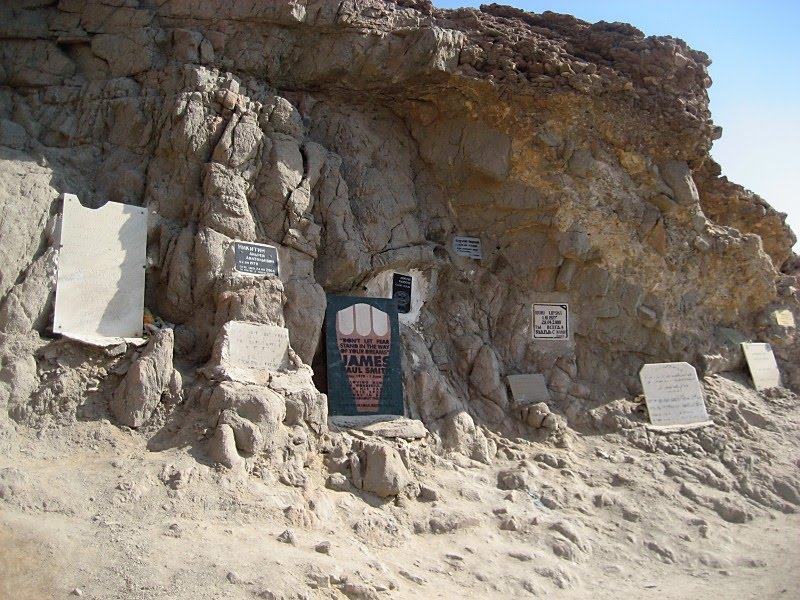
Dead divers plaques beside the Blue Hole (photo by B. Cremmins).


An incredible free dive of the Arch at the Blue Hole.

I don't remember doing much that night. For some reason, diving is exhausting. You try to move as little as possible to save oxygen, but you still come out tired. Some people say it is from breathing the air in the tanks instead of regular air. Some say it is the extra pressure of the water. I just say it is time for a nap.


Our gear on the dive boat.


Ras Mohammed National Park.

Day three saw me heading to Sharm el-Sheikh at 3am to catch a dive boat to three dives at a shipwreck and national park.. At the shipwreck, we would do two dives. The first would be around the outside of the hull. The second one would be into the ship itself. The wrecked ship, the SS Thistlegorm, was a British vessel being used to transport military supplies. It was bombed while anchored. The way it exploded has made it very easy for divers to get in and out. Unfortunately for me, it isn't quite easy enough.


BSA motorcycles and their inflated tired aboard the shipwrecked SS Thistlegorm (photo from Internet).


A mock up of the SS Thistlegorm shipwreck dive site (photo from Internet).

There was a small hatch that we were using to navigate between two levels of the ship. I was not moving fast enough and received a push from below which forced me to reach out and grab something to keep from going up too fast. The piece of metal that I grabbed was really sharp. I ended up bleeding for the rest of the day. I still have a scar. On a much cooler note, you could still see motorcycles and trucks in the storage part of the vessel. You could see the anti-aircraft gun on deck. There was an air pocket in a cabin that we each took turns poking are heads into, but making sure not to breath in the old air.


Giant moray eel (photo from Internet).

On the way back to Sharm el-Sheikh, we made a final drift dive at Ras Mohammed National Park where we got in at one place, but got out at another. At this dive site, you are hoping for big currents because they bring in the big animals, but we did not get them. We did get to see another wreck that was hauling bathtubs and toilets though. It was strange to see that stuff piled up on the ocean floor. On this dive, I also got to see my first giant moray eel. It was huge! I'm sure my eyes made it to be bigger than it actually was, but it easily looked 1 foot around its head and 10 feet long. We saw 4 of them. They have a bad reputation for attacking people, but a lot of those attacks are from when humans mess with their burrows or in poor visibility when a finger might look like a fish! I kept my distance.


The old market of Sharm el-Sheikh. Eh.

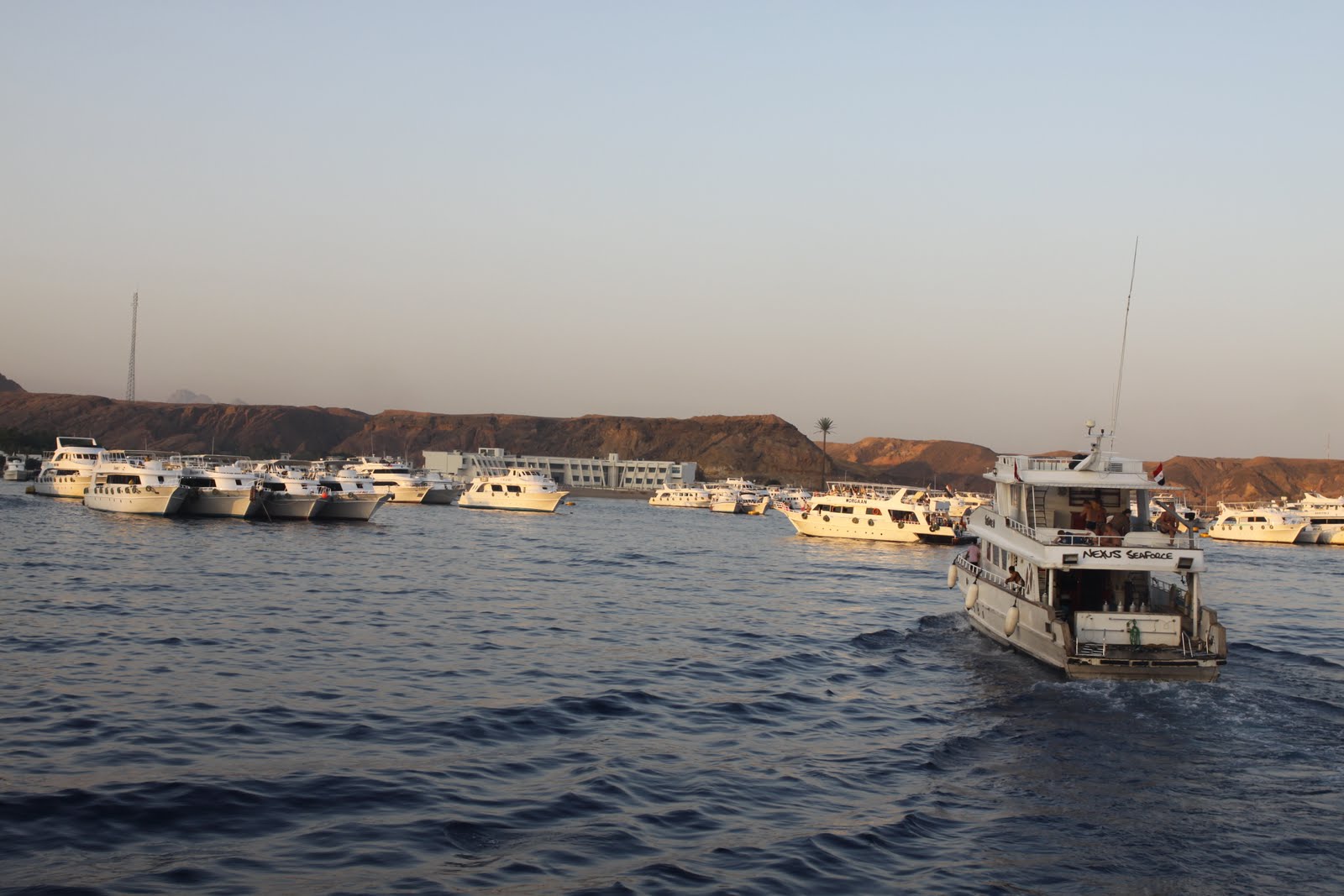
After returning to port, we had a quick look around Sharm el-Sheikh. It was supposed to have all of Dahab's diving mixed it with some ritz. It didn't seem that much different than Dahab. The beachfront was taken up by western style hotels that were far beyond anything Dahab had, but when you got away from the water, it was the same. I didn't like it. However, it was definitely a diving mecca. The number of dive boats in harbor was ridiculous.


The Sharm el-Sheikh dive boat harbor.

That night Betty raved about her visit to the Blue Hole. She was definitely hooked on diving. We celebrated at a burger joint run by a Kiwi woman with a couple other travelers. It was my second Kiwi encounter of the day. On my dive ship, there was also a Kiwi from Ashburton. I was excited to be done with Dahab. I had really enjoyed my diving, but it was time to move on. I definitely wanted to stay in one place, but Dahab was not the place for me. I'm not sure why even though I'd love to go back for more diving or to try windsurfing and kite boarding.